I thought I understood online word games. You look for useful letters, avoid repeating characters too early, and hope the answer doesn’t contain an unexpected double consonant. Then I played Contexto and discovered that none of those habits mattered.
Contexto doesn’t care whether your guess shares a single letter with the secret word. It cares whether the two words are connected by meaning.
That small change completely reshapes the experience. Instead of rearranging letters, you wander through ideas. A guess may lead you toward food, travel, medicine, work, family, or some strangely specific corner of everyday life. You keep moving through those associations until you find the hidden word ranked number one.
Honestly, Contexto feels less like solving a spelling puzzle and more like trying to understand what another person is thinking.
How Contexto Works
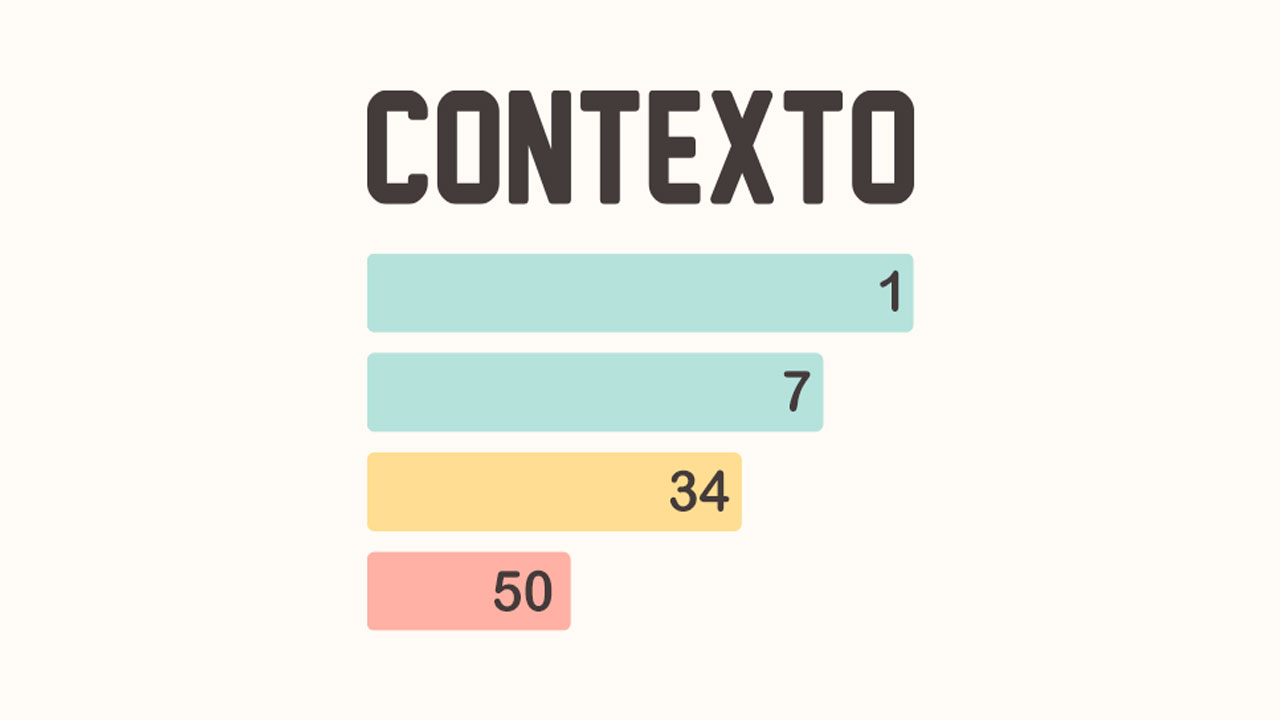
The rules are almost suspiciously simple. You enter any word, and the game gives it a numerical rank based on how contextually close it is to the secret answer. Lower numbers are better. A word ranked 200 is much warmer than one ranked 12,000, while the number-one word is the solution.
The daily puzzle on the official Contexto website allows unlimited guesses, so you don’t lose because you reached a fixed attempt limit. Instead, your final guess count becomes a measure of how directly you navigated toward the answer.
Contexto determines similarity by analyzing how words are used in large collections of text. Words that regularly appear in similar situations tend to rank near one another, even when they aren’t direct synonyms.
Let’s imagine the answer is “hospital.” Words such as doctor, patient, nurse, surgery, and clinic may all perform well because they frequently appear in the same context. A word that merely looks similar to “hospital” won’t help unless its meaning is related.
That distinction is important. Contexto is about association, not spelling.
Your First Guess Is Just a Direction Check
New players often stare at the empty input field and worry about choosing the perfect opening word. There isn’t one. With no starting clue, your first guess is basically a probe sent into the dark.
Use a broad, ordinary noun. You could try person, place, food, animal, object, work, water, house, or nature. The goal isn’t to get incredibly close immediately. You’re trying to discover which general part of language contains the answer.
I usually begin with something concrete because physical objects create useful branches. If “food” receives a strong rank, I can test meal, fruit, meat, restaurant, kitchen, and cooking. If those guesses become colder, perhaps the original connection was cultural or social rather than culinary.
Don’t spend too long exploring an area where every result is poor. Three distant guesses from the same category are usually enough. Move somewhere completely different and compare.
Basically, your early game should be wide. Your later game should become narrow.
Follow Meaning, Not Just Synonyms
One of the biggest mistakes in Contexto is treating it like a thesaurus. You find a warm word, then enter every synonym you can remember.
Sometimes that works. Often it doesn’t.
Suppose “school” receives a good rank. The answer might be education, student, teacher, classroom, homework, principal, uniform, or even bus. These words aren’t all synonyms for school, but they appear around the same subject.
Ask where the warm word appears, who uses it, what happens near it, and which objects or actions belong to that setting. This creates several paths instead of one narrow synonym chain.
I like to build what I informally call a context cloud. Around “school,” I might test people such as teacher and student, places such as classroom and library, objects such as book and desk, and activities such as study and learn. The rankings show which branch deserves more attention.
This is where Contexto becomes genuinely fascinating. The game makes you think about how language connects ideas rather than how a dictionary defines them.
Low Rankings Can Still Mislead You
A very warm guess doesn’t always point toward the answer in the way you expect. Two words may rank closely because they share a setting, not because they share a definition.
Imagine “knife” ranks well. You might immediately chase fork, spoon, and cutlery. Yet the answer could be chef, wound, kitchen, weapon, or surgery. The connection matters, but you still need to determine what kind of connection it is.
Experienced players should avoid becoming emotionally attached to their first warm category. I’ve spent far too many guesses circling a promising word because I decided the answer had to be one of its synonyms. Meanwhile, a completely different relationship was sitting nearby.
When progress stalls, return to your best-ranked guesses and look at them together. What situation could contain all of them? If doctor, room, and emergency are warm, the shared idea may be hospital. If bread, morning, and coffee perform well, perhaps you’re moving toward breakfast.
One guess offers a clue. A group of guesses offers context.
A Practical Strategy for New Players
Begin with several broad categories rather than a list of closely related words. Try one term connected to people, one to places, one to objects, one to nature, and one to actions. Compare the ranks and follow the strongest direction.
Once you find a moderately close word, explore around it using different relationships:
What larger category contains it?
What smaller examples belong to it?
Where would you normally find it?
Who uses it?
What actions are associated with it?
What usually appears beside it?
If “vehicle” is warm, test car, truck, road, driver, travel, engine, and traffic. Each answer explores a different part of the same semantic neighborhood.
Keep an eye on grammatical form too. If several strong guesses are actions, the answer may be a verb. If physical objects rank well, look for a noun. This isn’t a guaranteed rule, but it can help you stop bouncing between unrelated forms.
You should also keep your best words visible and mentally group them. Contexto normally sorts guesses by rank, making it easier to see which ideas are hottest. Use that list as a map rather than focusing only on the latest result.
What Regular Players Can Do Better
Experienced Contexto players often become good at finding the general topic but waste guesses during the final approach. Once you reach the top 100, broad categories are no longer enough. You need to examine finer relationships.
Try opposites, common pairings, parts of the same process, and words that appear in the same sentence. If “purchase” is extremely close, the answer might be buy, sale, price, customer, payment, order, or store. Move through the whole event, not just one definition.
Don’t ignore simple words. The secret answer is often more ordinary than the elaborate alternatives we invent. Puzzle players enjoy demonstrating vocabulary, but language models learn heavily from everyday usage. A common word may sit at the center of the cluster.
I’ve caught myself guessing terms that sound impressively precise while overlooking the word a child would have suggested first. Contexto has a way of humbling that instinct.
If the game offers a hint and you’re completely stuck, using it doesn’t destroy the experience. Study why the hinted word ranks well and use it to redirect your reasoning. The real satisfaction comes from understanding the connection, not protecting an imaginary reputation for never needing help.
Why Contexto Can Feel Unfair
Semantic similarity isn’t identical to human intuition. The system learns from patterns in text, so two words may appear close for reasons that aren’t immediately obvious. A rank can occasionally feel bizarre, especially when a seemingly perfect synonym performs worse than a loosely associated term.
That inconsistency is both a weakness and part of the game’s personality.
Contexto doesn’t provide the clean certainty of letter-based clues. In Wordle, a gray letter has a specific meaning. In Contexto, a distant rank only tells you that the connection is weak according to the underlying model. It doesn’t explain why.
Some puzzles therefore become long searches through neighboring ideas. Unlimited guesses prevent a hard failure, but they can also allow a frustrating session to continue indefinitely. You may reach guess 100 and feel no closer than you were at 40.
The minimalist presentation can also seem plain. Contexto relies almost entirely on its central mechanic, with little visual spectacle around it. I think that focus suits the game, although players looking for rewards, characters, or elaborate progression may find it sparse.
Contexto Versus Wordle
Comparing Contexto with Wordle is natural, but the two games exercise different skills. Wordle is about letter placement, probability, and spelling patterns. Contexto is about categories, relationships, and semantic association.
Wordle gives you a strict guess limit and usually ends within a few minutes. Contexto allows unlimited attempts, so a difficult puzzle can become a longer investigation.
I wouldn’t say one is harder. Wordle demands precision inside a small structure. Contexto gives you freedom, then asks you to find direction without clear boundaries.
If you enjoy crosswords, association games, language puzzles, or guessing what somebody means from partial clues, Contexto may feel especially appealing.
Final Verdict
Contexto is one of the most distinctive free online word games because it removes letters from the center of the puzzle. You succeed by understanding how words live beside one another in real language.
New players should begin with broad categories, follow the strongest ranks, and explore several types of connection around each warm word. Experienced players can improve by comparing clusters, changing direction sooner, and thinking beyond direct synonyms.
The semantic rankings occasionally feel strange, and some daily answers take longer than they deserve. Still, those unpredictable connections give Contexto a quality that cleaner puzzle systems often lack: every solution feels like a small journey.
You begin with a random word and no idea where you’re going. Thirty guesses later, you’re exploring the relationship between kitchens, heat, metal, and food while insisting the answer must be “oven.”
It’s “pan.”
Well, of course it is.